
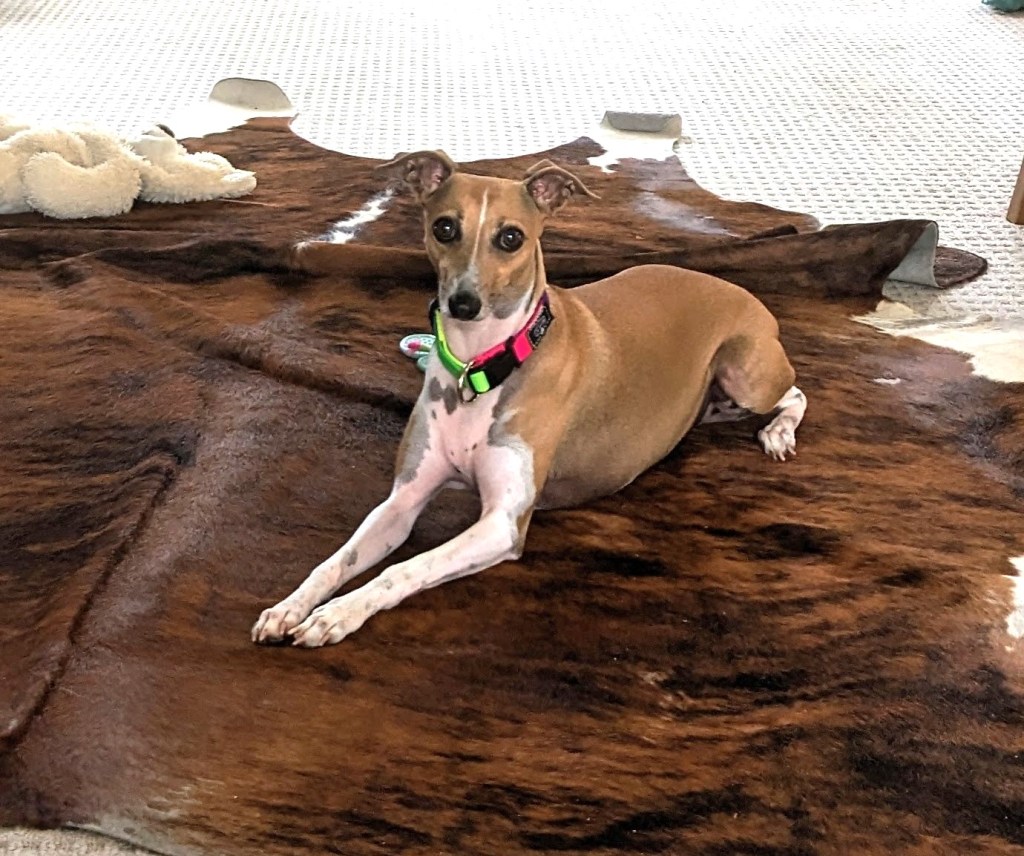
My littly Iggy (Italian Greyhound) is like my shadow. She follows me wherever I go. If I’m upstairs and I come down, so does she. When I go back up, she follows. Even if I’m going into another room to get something, there she is, right behind me. She has multiple sleeping places because of this. A place in every room. She even comes in to the bathroom. My one true companion.
People often wonder about the origin of these dogs: where do they come from? What were they used for? Were they racing dogs? I knew of one painting at the National Gallery of Victoria that depicted an Italian Greyhound, and I knew that they were often the preferred hound of royalty in the Renaissance. My passion for art history led me to explore their provenance.
The earliest depiction of these dogs is in early Mesopotamian hieroglyphs where they were believed to be descendants of jackals. They are also entombed in Eyptian pyramids. In Greek mythology, Atkaeon, while out hunting with his hounds, comes across the goddess Artemis bathing. She turns him into a stag as punishment for oserving her. Atkaeon’s hunting dogs – Italian greyhounds – mistake him for prey and kill him. Such are the cautionary tales of Greek myths.

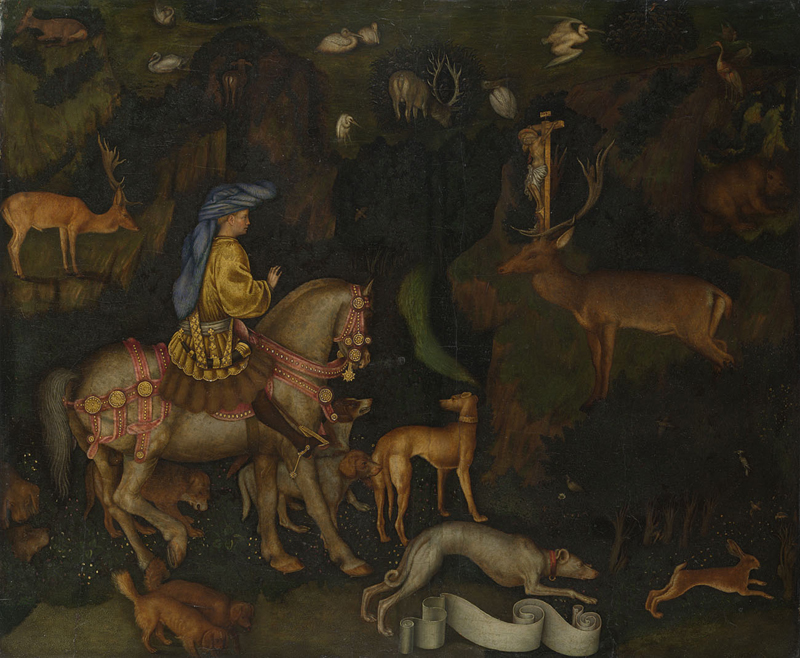
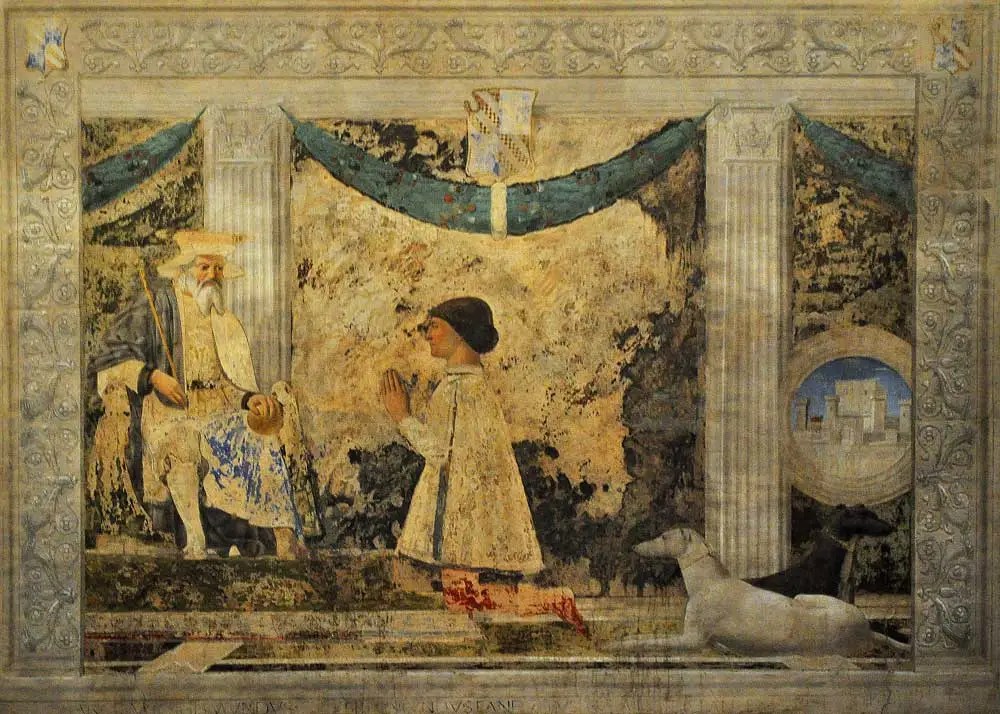
These hounds are depicted in paintings in the Middle Ages (5th -14th century) in Southern Europe (predominantly Italy). However it is during the Renaissance, a time of wealth and power and a desire to be immortalised by the best artists, that these greyhounds become associated with nobility and it was due to their popularity that they earned the name Italian Greyhound. Originally used as a hunting dog, they gradually become aristocratic pets. Instances in painting occur with them depicted with royalty and nobility, and their popularioty spread to England, Russia, Denmark and Prussia.

In this painting of The Wedding Feast at Cana by Fantin-Latouried the two Iggies in the foreground are tied together by the same leash, one dog lies on the ground and gnaws on a bone while the other stands up alert looking off to the right, pulling at his companion. His attention has been caught by the miracle taking place, as astonished servants see that Christ has transformed water into wine (or maybe the dog is actually transfixed by the cat pawing at the wine jug). We, the viewers, are like these dogs: half of us is consumed by the lavish feast, half focused on the divine event.
Perhaps the most famous painting is the one depicting the love affair between the Roman consul Mark Antony and the Egyptian queen, Cleopatra. Tiepolo represents an account from Pliny’s Natural Hisory (AD 77) which recounts the tale of a famous contest between the Egyptian and Roman rulers whereby Cleopatra wagered that she could stage a feast more lavish than the legendary excesses of Mark Antony.
Tiepolo shows the dramatic moment at the end of Cleopatra’s feast when, faced with a still scornful Mark Antony, she wins the wager with her trump card. Removing one of a pair of priceless pearl earrings, Cleopatra dissolves it in a glass of vinegar and drinks it, thereby causing Mark Antony to lose his bet.
This was one of the paintings that I pointed out to my small children at the gallery in order to imbue a sense of interest in art: “look at the dogs in this painting.” Pointing out such things gets kids interested in looking art. A great technique.


 tania j layden